
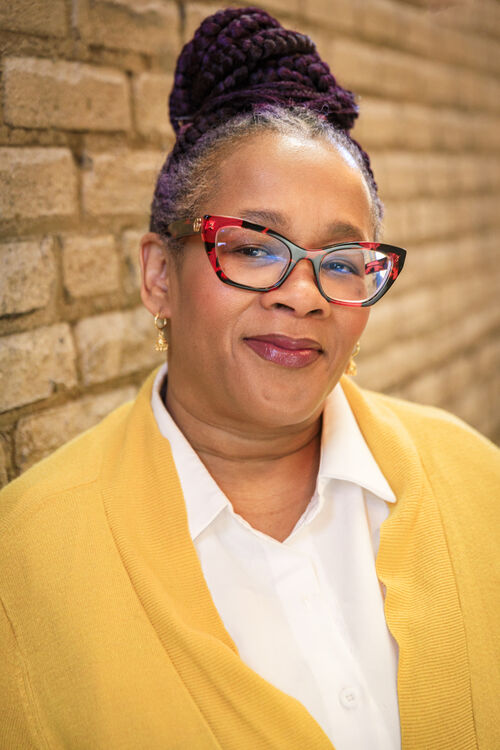
To honor the 100th year of Black History Month with intention, we sat down with our own Rashida Jackson for a Q&A on the significance of Black History Month. Here are her answers, minimally edited for clarity.
Question 1: 64% of PPL staff are people of color, with 37% identifying as African American. How does this level of staff diversity impact you, both personally and professionally?
Rashida: Beyond the number and collection of diversity, what impacts me the most is that we are all encouraged to expand our racial equity lens, recognize and challenge our biases, and move with authenticity. I love that for me and for the other Black staff at PPL.
Question 2: 2026 is the 100th anniversary of Black History Month. Is this month typically something you recognize in your personal life? What does it mean to you?
Rashida: Wow—100 years. I celebrate Black history every single day of my life, not just in February. My relationship to Black History Month is deeply intersectional. I honor Black history alongside the histories of Indigenous peoples and other communities whose lives, labor, resistance, and brilliance are inseparable from the making of the Americas. I am moved by the shared threads, forced migration, survival, cultural preservation, joy, and liberation, that bind our histories together. Personally, Black History Month is both a grounding and a reckoning. It is an opportunity for young people to be re-educated and rooted in truth, beyond sanitized narratives, so they understand that Black history is not marginal, but foundational. It is also a necessary moment for white people and non-Black people of color to engage deeply with the richness, complexity, and global impact of Black history, while honestly confronting their own biases, discomfort, and fears. For me, Black History Month is not symbolic; it is an invitation to reflection, accountability, and collective responsibility--one that remains urgent 100 years in.
Question 3: Race equity is one of PPL's strategic pillars. Do you have any thoughts on race equity in the workplace you'd like to share?
Rashida: Race equity in the workplace is about outcomes, not intentions. Treating everyone the same often reinforces existing inequities because workplaces were not designed to be neutral. True equity requires examining who holds power, who advances, whose leadership is trusted, and who bears invisible labor without authority or compensation. Real progress comes from structural accountability, measuring outcomes, responding to harm, and changing systems when inequities persist. An equitable workplace is one where people can name race, power, and impact without fear, and where dignity, fairness, and opportunity are not conditional.
Question 4: Do you feel PPL is a strong champion of race equity in the workplace?
Rashida: Yes, PPL is a strong champion of race equity, and we have not arrived. Equity is not a one-time achievement; it requires sustained commitment while we continue doing the day-to-day work of the organization. Both must happen at the same time. I often think of Coretta Scott King’s words: “Struggle is a never-ending process. Freedom is never really won; you earn it and win it in every generation.” I would add that we must be clear about what we are struggling for. The struggle should not be for Black people to prove our worth or work twice as hard—those expectations are rooted in whiteness. The true struggle is to honor how far we’ve come, recognize what we’ve accomplished, and continue pushing forward so that liberation and dignity are possible for everyone.
Question 5: Are there any Black leaders (locally or nationally) who have influenced you and who you'd like to recognize?
Rashida: The Black leaders who have most influenced me begin with my family. My Aunt Ruby taught me how to make hard business decisions when family and friendship are involved, how to lead with clarity without losing your values. My Aunt Maudessa constantly reminded me to “be a lady,” which I now understand as an early lesson in navigating expectations while maintaining self-respect and composure. I was blessed to have three grandmothers, each of whom were extraordinary operational leaders. They planned everything, logistics, travel, housing, food, budgets, and timing. They knew who could come now, who needed to stay behind, and how to prepare for the next gathering, the next crisis, the next opportunity. They were strategists long before the language existed. My mother taught us to always have our own. Don’t wait on anyone. That lesson came from trauma and survival, but survival is necessary. It was preparation for a world that would not always offer safety or fairness, and it shaped my independence and resolve. Beyond my family, I am deeply influenced by Black women whose leadership, courage, and brilliance reshaped this country and my thinking: Audre Lorde, Shirley Chisholm, Barbara Jordan, Angela Davis, June Jordan, Nikki Giovanni, Eartha Kitt, Alice Walker, Aretha Franklin, Wilma Rudolph, Fannie Lou Hamer, Diane Nash, Mamie Till-Mobley, Septima Clark, Bessie Coleman, Gloria Richardson, Ida B. Wells, Mary Church Terrell, Sister Rosetta Tharpe, Recy Taylor, Daisy Bates, and so many others. They remind me that Black leadership has always been expansive: intellectual, political, artistic, strategic, and deeply human. I carry all of them with me.