
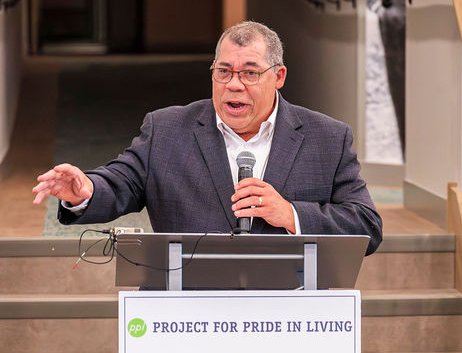
As PPL celebrates the Grand Opening of The Williams, we mark more than the completion of a new building. We honor a legacy shaped by generations of community care, resilience, and service. Paul Williams, former President and CEO of PPL, retired in January 2025 after more than a decade of leadership. While he has stepped away from day-to-day operations, his life’s work and his family’s history continues through this place and the people who now call it home. We sat down with Paul to talk about how The Williams came to be, what it means for the building to carry his family name, and the legacy he hopes it leaves for residents and for the city.
Q: You often describe housing as “place-making.” What does that mean in the context of The Williams?
Paul Williams: This is a beautiful building and that matters. It will be additive to the community. Affordable housing shouldn’t be hidden or diminished. People deserve beauty. We deserve to be here. We deserve to be part of the city as valued, productive community members.
For East 7th Street and the East Side more broadly, an investment like this sends a message: this neighborhood matters, and the people who live here matter.
Q: What makes The Williams different from other housing developments?
Paul Williams: Some elements of this project are similar to others—the financing, the partners and the process, to a certain extent. Affordable housing that serves households at different income levels is something our field knows how to do, even though it’s always difficult. What’s different here is the emphasis on three- and four-bedroom units. There’s a huge need for family-sized housing at an affordable price point, and you don’t always see that prioritized.
In many communities, particularly immigrant communities, you see grandparents, parents, and children living together. Our early outreach work also recognized the growing reality that there are grandparents who are raising their grandchildren. That reality shaped the vision - larger units, flexible spaces, and support services designed around how families actually live.
We were also able to include meaningful community spaces, which isn’t always possible once you stack up all the costs and requirements. And then there’s the site itself. This was once a heavily polluted former 3M factory location. Seeing it transformed into a beautiful, productive community asset is incredibly powerful.
Q: The building carries your name and your family’s name. How did that land with you?
Paul Williams: I was genuinely surprised and deeply humbled. My family doesn’t seek recognition - we’re worker bees. But we are a proud family, and there’s a long history there.
The Williams family legacy goes back generations. My grandparents, great aunts, and great uncles were deeply rooted in Saint Paul neighborhoods, especially Rondo, but really across the city. They were involved in community organizations, in rebuilding community, in making sure neighborhoods weren’t forgotten.
One of my uncles, who recently passed away at 95, was an early Black PhD cancer researcher at the University of Minnesota. But he was also a fixture at the downtown Saint Paul YMCA, where he taught judo for decades. Thousands of kids passed through those classes learning discipline, self-respect, and a sense of self, not just judo.
Another great aunt spent years pushing the city to invest in the Jimmy Lee Recreation Center, badgering the city, honestly, until it finally happened. She understood how important those spaces were for kids and families in the inner city.
My dad, the oldest of ten siblings, worked as a family court referee. That meant dealing with some of the hardest moments in people’s lives - mental health commitments, custody cases, juvenile issues. Later in his career, he was honored by the Hmong Council of 18 because he took the time to deeply understand Hmong culture and interpret the law through a cultural lens.
So, when I think about the building carrying our name, it’s not about me. It’s about generations of people showing up for their community in quiet, consistent ways.
Q: You’ve said that this isn’t an “us and them” story. What do you mean by that?
Paul Williams: Absolutely. This isn’t somebody else living here. These are our people.
My family has experienced addiction. We’ve lost family members to homelessness. Mental illness and schizophrenia were very real in our family. We saw young people lose their way.
So this building isn’t about “us” helping “them.” There’s no separation there. The families who live in The Williams reflect the same struggles, strength, and resilience that shaped my own family and the families of many at PPL. That connection is real.
Q: The name The Williams is reflected not just on the building, but in the logo itself. Can you share that story?
Paul Williams: The designers brought forward several concepts, and one of them really stood out—the subtle underscore beneath the letters “A M.” That idea came from Eduardo Barrera, a PPL team member, dear friend and longtime community development leader.
That “I AM” immediately resonated with me. It echoes the affirmation so powerfully voiced by the Rev. Jesse Jackson, who recently passed away: “I am somebody.”
The people who live in this building are somebody. This community is somebody. Dignity matters. Pride matters. Joe Selvaggio, PPL’s founder, believed deeply in dignity and self-worth, and that belief is woven into this organization and into this building.
That underscored AM speaks to voice, humanity, and belonging. It’s a quiet design choice—but it says everything.
Q: What do you hope residents feel when they call The Williams home?
Paul Williams: Stability is the foundation. Quality, affordable housing is a base - everything flows from that. I’ve talked to families who say that after just a few months, their kids are doing better in school, they’re able to finish a degree, get to work more consistently.
But beyond stability, I hope this is a place of dignity, safety, and hope. People are remarkably resilient, even when so much is stacked against them. Housing like this should reinforce that resilience, not make life harder.
Q: When people look back years from now, what legacy do you hope The Williams leaves?
Paul Williams: I hope it’s remembered as a place where lives were stabilized and voices were affirmed. I recently came across a quote that says “We’re wired to care for one another, for our neighborhoods.” I love that and I hope that folks realize that we’re all a part of a shared safety net.
This building reflects that belief: that affordable housing can be beautiful, that community partnerships matter, and that dignity belongs at the center of everything we build.
A Living Legacy
The Williams opens its doors carrying generations of family history, years of community collaboration, and a simple but powerful truth reflected in its name and its design:
I am human.
I am somebody.
For residents, it is home. For the East Side, it is an investment. And for the city, it stands as a living reminder of what becomes possible when we center dignity, belonging, and community.